


Humming Along
- Elaine Johnson
- Aug 24, 2022
- 3 min read
Updated: Apr 19, 2024
Thanks to Dellana for spotting this tiny pollinator in the Good News Garden. For those of us who make every effort to lure these enchanting birds to our gardens with feeders and enticing flowers, seeing a hummingbird in action always feels like a blessing.
For me, they're also a source of endless fascination and unabashed affection. I'm glad Dellana's sharp eyes and excellent photo skills are giving me the opportunity to share my obsession with readers. For example, did you know that hummingbirds exist only in the western hemisphere, with Central and South America home to more than 300 species? Here in the U.S., there are 26 species, most of which live in the south and west. Only ruby-throated hummingbirds, which begin their lives in nests the size of a large thimble, call Chicagoland home. Females and juveniles of the species sport beautiful iridescent-green feathers and white bellies while mature males also display a collar of deep red feathers. These delicate birds measure just 3 to 3-1/2 inches in length and weigh a mere 0.11 ounces. But they are mighty!
Hummingbirds typically arrive in Downers Grove in April or May after wintering in Mexico, and head south again by the end of October. When migrating, they can travel up to 23 miles a day, eating insects on the wing and flying low in order to spot sources of nectar.
And they move quickly -- 30 mph in direct flight. When courting, the male ruby-throated hummingbird dives 45 mph to the female then bolts back up into the sky in a U-shaped flight pattern. The centripetal acceleration of his flight delivers 10Xg forces (compared to the maximum 7Xg forces experienced by fighter pilots). Hummingbirds also are the only bird species that can hover in mid-flight and also fly backward and upside down.
Tiny hummingbird hearts beat an incredible 1,200 times per minute when flying and 225 times per minute while at rest. Their heart rate slows so dramatically because they are able to go quickly into a deep sleep-like state in which their metabolic functions are ratcheted down to a bare minimum and their body temperature plummets. This resting state, called torpor, allows them to conserve energy and survive when conditions aren't conducive to maintaining their 105-degree Fahrenheit body temperature.
This survival mechanism is essential considering the metabolic demands of a hummingbird's existence. Those little wings -- which appear as a blur to human eyes -- move 70 times per second in regular flight and 200 times per second during a dive. No surprise that it takes a lot of food (relatively speaking) to sustain this level of activity. Hummingbirds eat every 10 to 15 minutes, all day long, and consume about half their body weight in nectar and insects. They can visit as many as 1,000 to 2,000 flowers in a day, drinking in the nectar with tube-like tongues.
Given their need for constant nourishment, it's perhaps not surprising that hummingbirds are very territorial. If you have a hummingbird feeder, you've undoubtedly witnessed the aggressive behavior that erupts when two birds want to eat at the same time. There may be plenty of nectar for everyone (and six feeding stations), but that doesn't stop one hummingbird from chasing off the other, often chirping threats the whole time. Things get even more vicious during mating season, when males may wield their needle-like beaks as weapons, stabbing a competing suitor in the throat.
If this isn't enough to convince you that hummers are amazing little creatures, consider that the brain of a hummingbird is proportionally larger than that of any other bird, at 4.2% of its body weight. (Human brains weigh in at 2% of our body weight, by way of comparison). And that brainpower isn't wasted. Scientists have determined that hummingbirds not only remember migration routes, but also recall the flowers they've visited and calculate how long it will take them to produce more nectar.
And note to Dellana: They also can recognize humans.


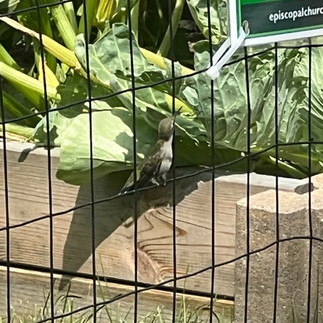
A female hummingbird sips nectar from the Good News Garden's massive marigolds then rests from her labors. Dellana Mote photos


Comments